Dr. Gymbro
←

#women lifters

1 article
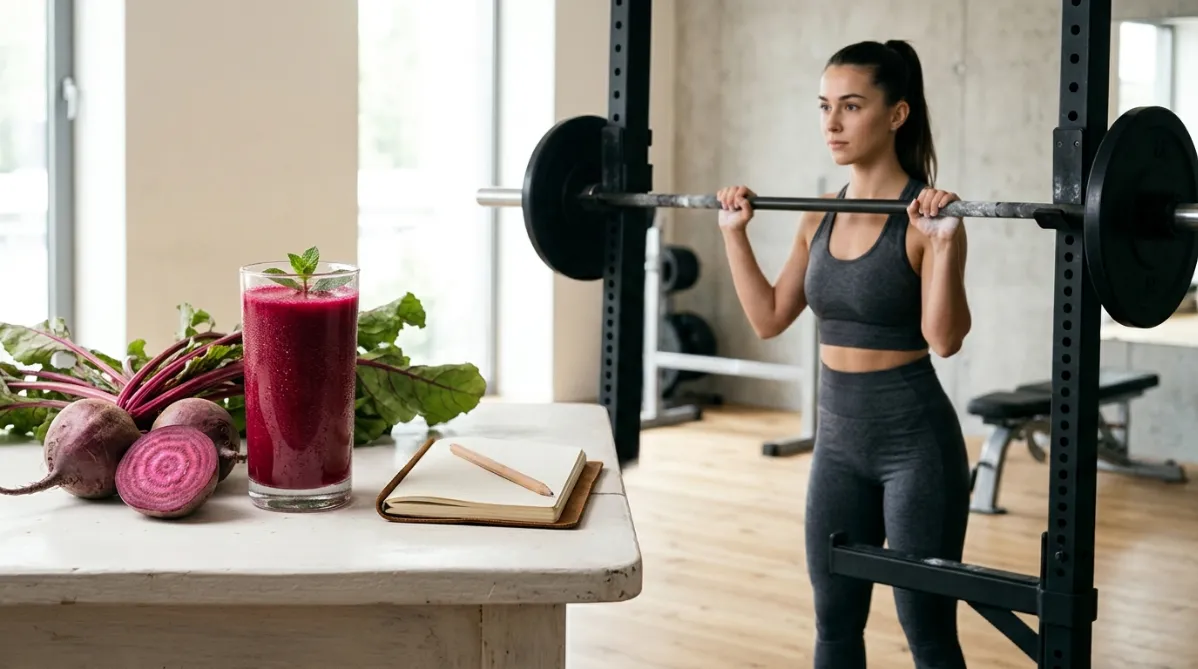
A wide, editorial-style photograph of a bright, modern gym corner softened by morning window light. In the foreground, a rustic matte-white ceramic table holds a tall clear glass of deep magenta beetroot juice, beads of condensation on the glass, a few fresh whole beetroots with leafy crimson-veined stems beside it, and one beetroot sliced in half to reveal its vivid concentric purple-pink rings. Next to the glass sits a small, neat notebook with a pencil, suggesting a research note, with no legible text. Behind the table, slightly out of focus, a young woman lifter with a tidy ponytail and a fitted charcoal training set stands at a barbell resting on a squat rack, chalk-dusted hands gripping the bar, calm and focused expression. A loaded bench with a bar is visible further back, with matte black plates and a light wooden floor. The palette is restrained and trendy: warm off-white, soft concrete gray, muted sage green accents from the beet leaves, and a bold beetroot magenta as the focal color. Shallow depth of field with a creamy bokeh background, natural side lighting casting long gentle shadows, subtle film grain. Composition follows the rule of thirds, with the juice and beets on the left third and the lifter on the right, leaving clean negative space in the upper area for a headline overlay. Mood is thoughtful, clean, and slightly skeptical, like a contemporary health and science journal cover. Realistic photography style, high-end magazine look, no text, no logos, no futuristic elements.
nutrition

Rote‑Bete‑Saft enttäuscht weibliche Kraftsportlerinnen – und verlangsamt sogar das Bankdrücken

BY DR. GYMBRO ·

Rote‑Bete‑Saft gilt als natürlicher Leistungs‑Booster, doch eine neue Crossover‑Studie mit 18 krafttrainierten Frauen zeigte keinerlei Vorteil bei Kniebeugen. Noch überraschender: Beim Bankdrücken sank die Leistung bei einer Belastung von 60 % 1RM leicht, nachdem etwa 6,7 mmol Nitrat etwa 2,5 Stunden vor dem Training konsumiert wurden. Der Unterschied betrug nur rund 5 W und 0,02 m/s und erreichte gerade so die Signifikanz, sodass kein definitives Urteil möglich ist. Die Studie testete nur ein paar leichte bis mittlere Lasten und kurze Sätze, sodass sie keine Aussagen über maximale oder lang‑dauernde Belastungen zulässt. Wer trotzdem experimentieren will, sollte die Dosierung und das Timing beachten.

This page is available in